
Provence, France · Western Europe
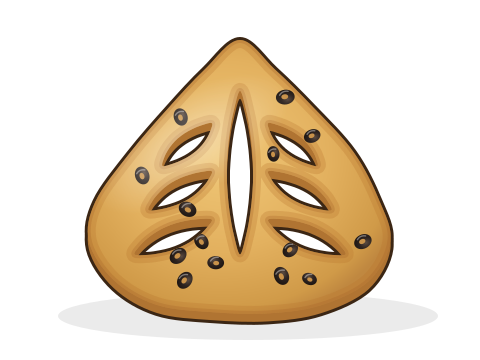
Fougasse
Levain and yeast in the recipes readThe leaf-shaped bread of Provence: a lean dough with olive oil, rolled flat, cut through in slanting slits and stretched so the cuts bake open — olives worked in, in two of the three recipes read.
Hydration 66–70%. A lean olive-oil dough · rolled flat, cut through and stretched open into a leaf
Water, oil and salt are where the three recipes read agree; Hamelman salts it at 1.5% because the olives are salty, and his has 10% whole wheat. The olives are 8% in Hamelman's and Modernist's; Suas uses rosemary instead. The olives' water and fat are from USDA's ripe canned olives (SR Legacy 169094), the nearest published row; the recipes' oil-cured and niçoise olives are drier. Two of the three raise it with a levain beside the yeast — Suas's at 15% of the flour, Modernist's liquid levain at 21% — and the version uses their median, 18%; Hamelman builds it on a pâte fermentée instead, the other way on this sheet. The bake is the median of the three: Hamelman 240 °C for about 20 minutes, Suas 232 °C for 35, Modernist 230 °C for 25–30 minutes for a 500 g piece on a preheated stone or steel — 232 °C, about 27½ minutes. Modernist brushes it with olive oil out of the oven.
The app's own version, from 3 published recipes from 3 sources.
Contains: wheat (cereals containing gluten). Check: oil — the kind you buy decides. From the plan's rows only — check the labels of what you buy.
Which way
- Levain and yeast
- Hamelman's pâte fermentée — Hamelman's Fougasse with Olives (Bread, pp. 366–368): 90% bread flour and 10% whole wheat, a pâte fermentée of 25% of the flour at 65% water, 2% salt and 0.2% fresh yeast, 12–16 hours at about 21 °C; 1.5% salt in all, reduced for the olives; 1.8% fresh yeast in all. Bulk 2 hours with one fold after an hour, 454 g pieces rested 20 minutes, rolled and cut into a triangle, proofed about an hour at 24 °C, baked at 240 °C for about 20 minutes with steam.
Plan this bread in the app
Say when the bread should be ready and how much you want to bake, with yeast or sourdough. The app then plans backwards: every step with a clock time, around your sleep and your day, for up to three doughs at once.


For iPhone and Android.
 Pain de campagne
 Miche
 Baguette
 British tin loaf
 Crumpet
 English muffin
 Fastenwähe
 Bürli